
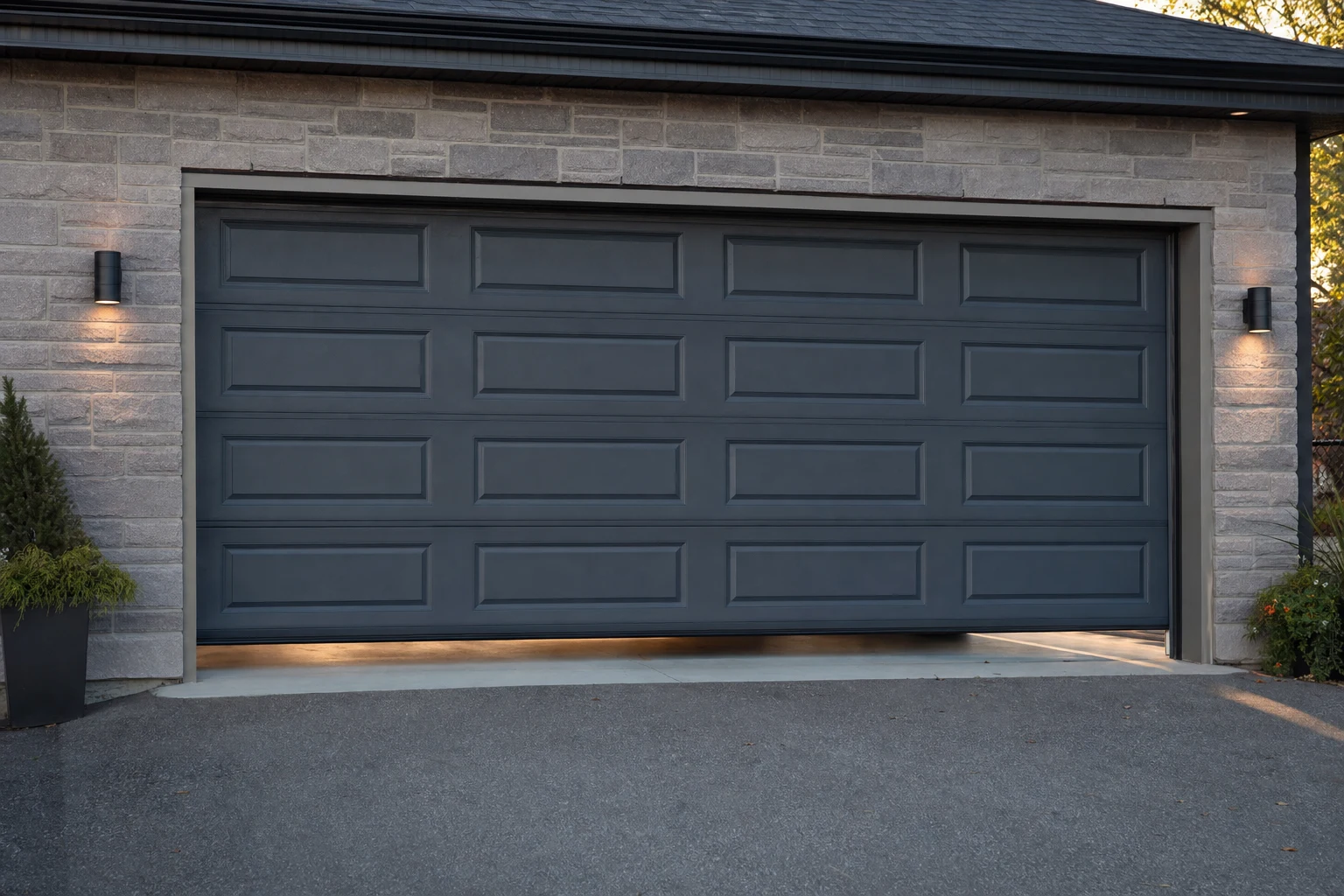
Garage Door Won't Close All the Way? 7 Things to Check Before You Call Anyone
Quick answer
If your garage door won't close all the way, it's almost always one of these 7 things — listed in the order we see them most often: dirty photo-eye sensors, wrong close-limit setting, damaged bottom seal, obstruction on the floor, worn rollers, broken cable, or a faulty opener logic board. The first 3 you can fix yourself in 10-15 minutes.
"It opens fine, just won't close all the way" is one of the most common problems we get called about in Ottawa — and it's also the problem with the highest DIY-fix rate. Before you book a service call, run through these 7 checks in order. About 60% of the time you'll find the culprit yourself.
1 Photo-eye sensors are dirty or misaligned
Every garage door installed in North America since 1993 has two small sensors near the bottom of the track, about 6 inches off the ground — one on each side. They beam an invisible infrared signal across the doorway. If anything breaks the beam (or if the sensors lose alignment with each other), the door refuses to close. It's a federal safety feature and it's the #1 cause of "won't close" calls.
How to check: Look at the LED indicator on each sensor.
- Both lit, steady: Sensors are working. Move to step 2.
- One blinking, the other steady: They're misaligned. Gently bend the bracket of the blinking sensor toward the other until both LEDs are steady.
- One off completely: Wiring problem or dead sensor. Wipe the lens, check the wires for damage. If still dead, call a tech.
- Both lit but flickering: Probably moisture or dust on the lens. Wipe both with a clean dry cloth.
Ottawa-specific note: in winter, road salt spray and condensation are the biggest sensor contaminators. In summer, it's spider webs. In fall, it's leaves and dust. Wipe the sensors with a dry cloth every 2-3 months and you'll never see this problem.
2 Close-limit switch is set wrong
Every garage door opener has two travel-limit settings: how far up the door goes, and how far down. If the close-limit is set too far (the opener thinks the door should travel further than it actually can), the door hits the floor and the safety system reverses it.
How to check: Look at your opener motor. There's a small label near the back showing "UP" and "DOWN" dials or buttons. If you've recently had a power outage, replaced an opener, or had someone work on the door, the limits may have shifted.
To adjust: Turn the DOWN dial counter-clockwise 1/8 turn (or hold the DOWN button for 1 second, depending on the opener brand). Test. If still reversing, another 1/8. Don't overdo it — past a half-turn without progress, you'll damage the rollers or jam the door.
3 Damaged bottom seal or obstruction on the floor
The door tries to close on something — even something small. Common culprits:
- A piece of ice, gravel, or salt build-up under the door (very common after Ottawa winters)
- A torn or curled section of bottom rubber seal that's hanging down further than the rest
- A leaf or debris pile
- An uneven garage floor that's developed a slight crack or hump
- A garden hose, kid's toy, or extension cord left across the threshold
This is the easiest check: walk into the garage, sweep the floor under the door, look at the bottom seal. If the seal is shredded, replace it (it's a 30-minute job on most doors and the cheapest fix in the whole garage).
4 Worn or broken rollers
The 10-12 small wheels along the side of each door panel are called rollers. They roll along the inside of the track as the door moves. When a roller cracks, wears flat, or comes off its bearing, the door catches on the track at that point and reverses.
How to check: Open the door fully and look at each roller. They should all be intact, round, and spinning freely as you flex the door slightly. A roller that's stuck, oval-shaped, or missing rubber/nylon is the problem.
Fix: Rollers are a tech job — replacing them requires removing the hinges that hold them in the panel, which involves opening the door system. Don't try this yourself. Budget for a full roller set replacement if more than 2-3 are worn (they all age together).
5 Broken or stretched cable
The lift cables on each side of the door wrap around drums at the top corners. If one cable stretches (common after 8-10 years) or breaks completely, the door becomes uneven. The opener tries to close but one side closes faster than the other, the door binds against the track, and the opener reverses to protect itself.
How to check: Look at the cable on each side of the door. Frayed? Hanging loose? Off the drum spool? Stretched and missing tension? Any of those = service call.
Don't operate the door with a visibly broken cable — a sudden snap can cause the door to drop with no warning. Disconnect the opener (red rope) and call us. See cable repair.
6 Track is bent or out of alignment
The vertical and horizontal tracks the door rolls in should be straight and parallel. After a bump from a car, a hard wind event, or simply 15 years of small impacts, a track can bend or shift. The door binds at the bent section and reverses.
How to check: Stand at the side of the door and look down the length of the track. Any visible bends, kinks, dents, or wide spots? If yes, that's your problem.
Fix: Minor track adjustments can be done by loosening the track bolts, gently nudging the track straight, and retightening. Bigger bends mean track replacement. Either way, this is a tech job — adjusting a track wrong puts the whole door out of alignment.
7 Faulty opener logic board
Modern garage door openers have a small computer board inside. If it's failing — common in units 10+ years old, especially after power surges — the close-cycle logic gets confused. The opener may close partway and stop, refuse to close at all, or behave randomly day to day.
How to know: If you've checked everything else and the door behavior is inconsistent (closes sometimes, reverses other times, no pattern), the board is the most likely suspect. Also look for: opener lights flashing in patterns, beeping that wasn't there before, or buttons working intermittently.
Fix: Sometimes a board can be replaced for less than the cost of a new opener. Sometimes the whole opener needs to be replaced. We diagnose this in 15-20 minutes on-site — it usually comes down to opener age and whether parts are still available. See opener repair.
If you've gone through all 7 checks and the door still won't close, stop trying to force it — every reversal cycle puts strain on the opener motor. Disconnect the opener (red rope), close the door manually so your garage is secure, and book a same-day service call. Call Michael at (613) 703-3921.
What we usually find on-site
From the last 100 "won't close" calls we ran in Ottawa, here's the breakdown of what the actual problem was:
- 34% — Photo-eye sensor issue (dirty, misaligned, or wiring corroded)
- 18% — Bottom seal torn, frozen, or obstruction on the floor
- 14% — Close-limit setting needed re-calibration
- 11% — Worn or broken rollers
- 9% — Cable failure (frayed, stretched, or off-drum)
- 7% — Track damage or alignment
- 5% — Opener logic board failure
- 2% — Something we hadn't seen before (door panel damage from impact, frame settlement, etc.)
The good news: the top 3 — making up 66% of all calls — are things you can often check or fix yourself before booking a tech. Worth 10 minutes of your time before picking up the phone.
Frequently asked questions
Why does my garage door reverse just before hitting the floor?
Almost always one of three things: misaligned photo-eye sensors, a close-limit switch set too far, or the door is hitting something on the floor.
My garage door closes 6 inches and goes back up. What's wrong?
The down-force setting on the opener thinks something is in the way. Cleanest causes: a damaged roller, a kinked or bent track, frozen seal, or the photo-eyes triggering.
Can I just adjust the close limit switch myself?
Yes, but carefully. The two small dials on the opener motor control travel. Turn the close-limit dial 1/8 turn toward 'down' and test. Don't crank it.
My garage door closes but a gap is left at the bottom. Is that the seal?
Usually yes. After 5-8 Ottawa winters the bottom rubber seal flattens and tears.
The remote works but the wall button doesn't. Why won't it close?
The wall button may have a 'lock' mode that disables the remote. And the wiring from the wall button to the opener can corrode in older garages.
Bottom line
"Won't close all the way" is the most diagnosable garage door problem there is — about two-thirds of the time, the homeowner finds the cause in 10 minutes by walking through the checklist above. The other third needs a tech, but that tech visit is usually short (45-60 minutes) and the parts are common. Call Michael at (613) 703-3921 if you'd rather skip the troubleshooting and just have us look.