
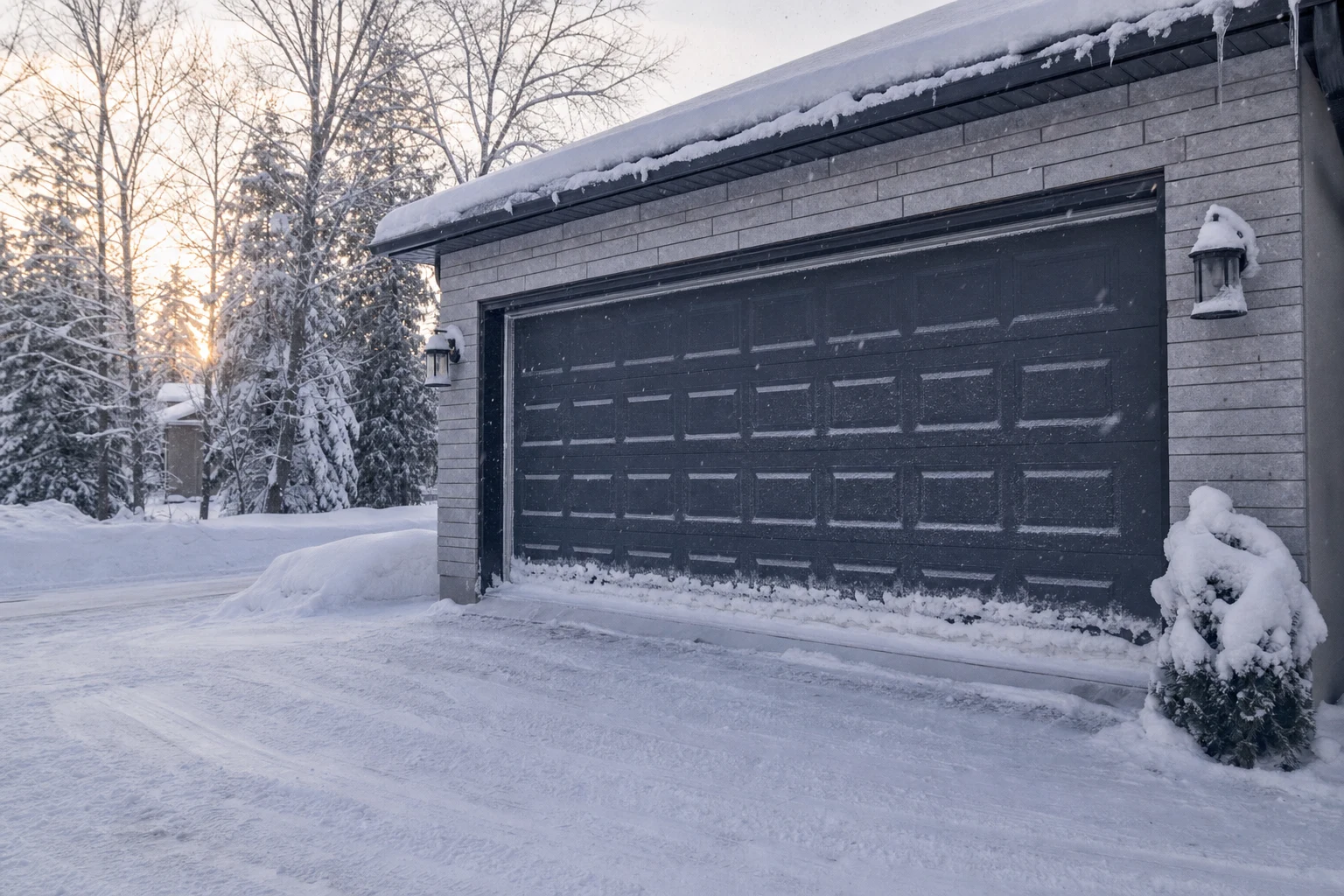
Garage Door Won't Open in Winter? 7 Ottawa-Specific Causes & Fixes
Quick answer
Ottawa winter breaks garage doors in 7 specific ways: frozen bottom seal, sluggish opener motor, brittle torsion springs, condensation-frozen tracks, dirty photo-eye sensors, snow-load on the door, and salt corrosion on cables. Each has a different fix — and a couple of them you can handle yourself in the next 10 minutes.
If you've ever pulled into the driveway at 7 AM on a January morning, hit the opener button, heard a sad mechanical groan, and watched nothing happen — congratulations, you live in Ottawa. Cold-weather garage door failures are the single biggest spike in our call volume every year. Between January and March we run more emergency repairs than in any other 90-day window.
Here's what we actually see going wrong, ranked by how often it shows up on the truck.
1 Bottom seal frozen to the concrete pad
What's happening: Water from melted snow seeps under the door, refreezes overnight, and glues the rubber bottom seal to the garage floor. When you hit the opener, the door tries to lift the entire seal off the concrete. The opener strains, the seal tears, or the photo-eye triggers and the door reverses.
How you'll know: Door opens 2 inches and stops. Or you hear the seal tear with a loud rip when it finally breaks free. Or the opener motor strains for 5 seconds then gives up.
What to do: stop using the opener if the bottom seal appears frozen to the ground. Do not pry, chip against, or force the door, and do not lift it to test whether it has released. Clear loose snow only where safely accessible and ask for service if the door remains stuck. Preventive care: follow the seal manufacturer's instructions.
If the seal is already torn, cracked, or stiff (which it is on most Ottawa doors over 5 years old), it needs replacing. We do this all winter long — see weather seals for what's involved.
2 Spring grease thickened from the cold
What's happening: Torsion springs are coated with grease from the factory. That grease is rated for room temperature. At -25°C, it turns into something closer to wax — the springs can't unwind smoothly, they store less energy, and the door becomes harder to lift.
How you'll know: The opener motor strains visibly. Door opens slowly. The door feels significantly heavier when you disconnect the opener and try to lift it manually.
Spring lubrication: follow the door manufacturer's maintenance instructions and leave hands-on spring work to a technician. Do not assume that opening the door makes the spring safe to touch, and do not service springs on a damaged or unstable door. We do this for free on any other service call.
Important: If you have to strain hard to lift the door by hand and it's not just a cold-weather thing, your springs are likely at end-of-life. Most residential springs are rated 10,000-15,000 cycles, which is about 7-12 years of normal use. Cold weather is often what pushes a tired spring over the edge.
3 Brittle springs snapping on the first morning cycle
What's happening: Cold steel is more brittle. A spring at end-of-life that would have lasted another 6 months in July often snaps on the first hard lift on a -20°C morning. We get most of our spring-replacement calls between mid-December and late February.
How you'll know: Loud BANG (often confused for a gunshot or a tree branch hitting the house) followed by the door being twice as heavy. The opener will just hum or click. You'll see a visible gap in the spring coils above the door.
The fix: This is a service call. Don't try to wind a new torsion spring yourself — they're under 200+ pounds of tension and have killed DIYers. We carry common Ottawa-area spring sizes on the truck and replace them in pairs (the second spring is also at end-of-life if one snapped). See spring repair for the full process.
4 Frozen track condensation
What's happening: Warm air from the house meets cold steel track inside the garage. Condensation forms, then freezes. Rollers can't roll properly across the iced track, the opener thinks it's hit an obstruction, and the door reverses.
How you'll know: Door opens 6-12 inches, reverses. Or opens partway, stops, and stays put. You'll see frost on the inside of the horizontal track sections.
The fix: Wipe the tracks dry with a clean rag. Then spray a thin coat of silicone lubricant on the rollers (not the track itself — never put grease in the track or rollers will skid). Long-term fix: install an insulated R-16 or higher garage door (this is the standard Liftime installs) so the temperature differential across the door is smaller.
5 Dirty or misaligned photo-eye sensors
What's happening: The two small "eye" sensors near the bottom of the track on each side talk to each other across an invisible beam. If snow, ice, road salt, or even a cobweb breaks the beam, the door refuses to close (or reverses immediately). One sensor blinks; the other stays solid.
How you'll know: You can open the door fine but it won't close. Or it closes 2 feet and bounces back up. Look at the small LEDs on each sensor — one should be green, one should be red or amber. If either is blinking or off, that's your problem.
The fix: Wipe both lenses with a clean dry cloth. Make sure they're aimed at each other (they're mounted on flexible brackets that bump out of alignment easily). If the LEDs are both lit but the door still won't close, the wiring may be corroded — that's a service call.
6 Snow load pressing down on the door
What's happening: A foot of heavy wet snow accumulates on top of the garage door's exterior — particularly common on doors recessed into the house wall rather than flush with it. The added weight overwhelms the springs (which are calibrated for the door's standard weight). The door becomes unliftable.
How you'll know: Snow visibly piled on top of the door. Opener can't lift it. Door creaks when you try.
The fix: Shovel or broom the snow off the top of the door before trying to operate it. Five seconds of prevention. We've seen homeowners shred a perfectly good set of springs trying to muscle a door open with 200 lbs of snow on it.
7 Road salt corroding cables and the bottom bracket
What's happening: Ottawa uses a lot of road salt. Salt-water spray off your car or boots collects on the garage floor, splashes onto the bottom bracket and lift cables, and accelerates rust. After 5-8 winters, a cable that should last 15 years frays or snaps. The door tilts crooked and shouldn't be operated.
How you'll know: Visible rust streaks on the bottom bracket or cable. Door hangs visibly crooked. Loud pop followed by lopsided travel. Cable visibly fraying at the bottom drum.
The fix: Replace cables in pairs (sized to door weight, galvanized aircraft cable). We also recommend a fresh bottom-bracket replacement if the original shows rust pitting. See cable repair.
What we tell people on the phone before we come out
When you call Michael at (613) 703-3921 for a winter no-open situation, here's what we'll usually walk you through first:
- Check the photo eyes first. Wipe them. Are both LEDs lit and steady?
- Do not release and lift a stuck door to diagnose it. Keep clear and describe the symptoms to a technician. A door that will not move may have a spring, cable, track or opener fault.
- Look up at the spring. Any visible gap in the coils? That's a broken spring — book a same-day call.
- Check the bottom seal. Is it stuck to the floor? Chip it free before doing anything else.
Most winter calls turn out to be one or two of the items above. About 60% of them, we can talk you through the fix on the phone and you save the service call entirely. Owner-operated means honest advice, including "you can fix this yourself in 10 minutes."
Frequently asked questions
Can I pour hot water on a frozen garage door?
Do not use hot water, a heat gun, or a pry tool to force a frozen door free. Stop using the opener and keep clear of the door. Follow the door manufacturer's guidance or call for service if the seal remains frozen.
Why does my garage door open fine in summer but get stuck in winter?
Three reasons: the bottom rubber seal freezes to the concrete pad, the spring grease thickens in the cold making the door heavier to lift, and condensation can freeze inside the opener track. All three are normal in Ottawa winters.
Will spraying WD-40 on my springs help in winter?
No — WD-40 is a solvent, not a lubricant, and it strips off the protective grease that's already on the springs. Use a proper garage door lubricant like white lithium grease or a silicone-based spray.
My garage door is heavy in winter even after I disconnect the opener. Is that normal?
Some weight increase is normal. But if you can barely lift it, your springs are probably at end-of-life and the cold pushed them over the edge.
Should I leave my garage door open in winter to keep it from freezing?
No — leaving it open invites pipes to freeze, rodents to move in, and your heating bill to spike. Fix the bottom seal so it doesn't freeze to the pad instead.
The bottom line
Most Ottawa winter garage door problems aren't catastrophic — they're maintenance debt finally coming due during the harshest 90 days of the year. A 15-minute lubrication in October prevents about 70% of the calls we run from December through February. If your door is already broken, call us at (613) 703-3921 and we'll give you an honest time window. If it's not broken yet but is making weird noises, schedule a tune-up before the cold snap hits.