
Ottawa Garage Door Maintenance Checklist: What to Do Every Spring and Fall
Quick answer
Inspect springs, cables, rollers, tracks, and seals twice a year (October + March). Lubricate with silicone spray — not WD-40. Run a balance test. If anything looks off, call before it fails in winter.
Ottawa's climate is genuinely hard on garage doors. Between November and March, temperatures swing from +5°C to -30°C within a single week. Road salt migrates everywhere. Freeze-thaw cycles work at every seal, every joint, every cable strand. Then summer brings 35°C heat and humidity.
Most cities can get away with one inspection per year. Ottawa needs two.
When to do it
Spring — March or April, after the last hard freeze. You're looking for what winter did to the door: cracked seals, rusted springs, freeze-damaged rollers.
Fall — October, before the first hard frost. You're preparing the door for five months of Ottawa winter. This is when you lubricate everything and catch anything that won't survive the cold.
Set a calendar reminder now. Twice a year, 20 minutes each time.
The owner's visual check — 10 minutes, no tools
Springs
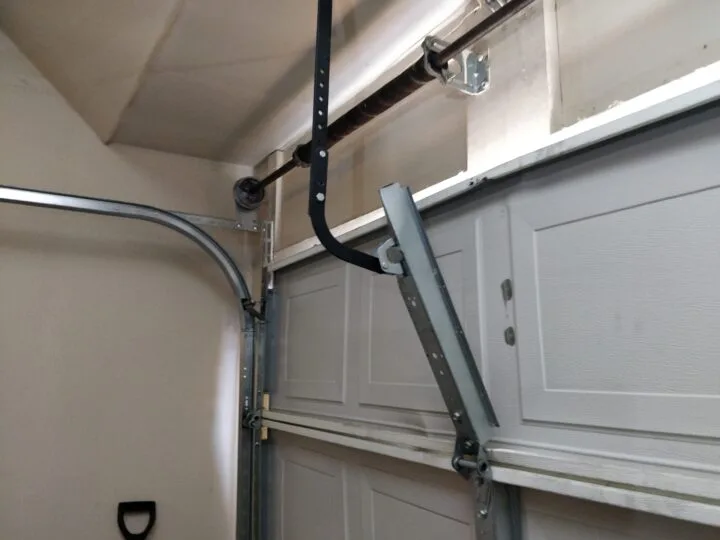
Look at the large spring (or springs, for double doors) above the door — the torsion spring mounted on a horizontal shaft. You're looking for a visible gap in the spring coil (it has snapped), rust deeper than surface level, or uneven coiling.
DO NOT TOUCH the springs under any circumstances. A torsion spring under load contains enough stored energy to cause serious injury if it releases unexpectedly. Look only.
Cables
Look at the steel cables on each side of the door, running from the bottom corner brackets up to the drum near the ceiling. You're looking for fraying (individual wire strands splaying out), kinking (a sharp permanent bend), or slack on one side (one cable noticeably looser than the other). If you see any of these, stop using the door, keep everyone clear, and arrange service before further operation. DO NOT TOUCH the cables — they're under significant tension even when the door is closed.
Rollers
Look at the small wheels on the door's edges: cracked or chipped nylon (the white or grey wheel portion), rollers that wobble visibly in the track, rollers that look seized — not spinning freely when the door moves.
Tracks
Look for dents or bends near the bottom of the vertical track (vehicle impact is the most common cause), gaps between the roller and the inside of the track channel, and debris packed in the channel — gravel, dried mud, leaves.
Bottom seal
This is the component Ottawa's climate destroys fastest. Look for cracking, gaps where the seal no longer contacts the ground, or missing pieces. A compromised bottom seal lets cold air, water, and rodents into the garage. It's one of the cheapest repairs (one of the more affordable garage door repairs) and one of the most neglected.
Balance test — the most important 30 seconds
Have the door balance checked by a technician if the door moves unevenly, is unusually heavy, or has visible damage. Do not release or lift a door with a suspected spring or cable fault, and do not let go of it as a test. Follow the exact door and opener manuals for any routine checks on an intact system.
- Door drops: springs are weak, worn, or under-tensioned
- Door shoots up: springs are over-tensioned
Either way, this is a tech job — see the section below on what only a tech should touch.
What you can lubricate yourself
Use silicone spray or white lithium grease. Apply in October (fall prep) and March (spring maintenance).
Do not use WD-40. WD-40 is a water-displacing solvent, not a lubricant. It cleans surfaces temporarily, then evaporates and leaves metal components dry and more prone to rust. I see this mistake on almost every service call — someone sprayed WD-40 on the springs in good faith and accelerated the very rusting they were trying to prevent.
Lubricate these:
- Rollers — spray the bearing at the center, not the nylon wheel body
- Hinges — the pivot point on each hinge where panels flex, a light coat
- Torsion spring — leave hands-on spring work to a technician. An open door does not make a spring safe to touch; follow the door manufacturer's maintenance instructions.
- Tracks — a light wipe along the inside of the vertical track with a silicone-dampened rag
Do NOT lubricate:
- The bottom seal — lubrication attracts grit and accelerates wear
- The plastic drive gear on the opener — designed to run dry; lubricating it causes faster wear from dust adhesion
What only a tech should adjust
Spring tension. If the balance test showed a problem, call a tech. Spring-related injuries are the leading cause of serious garage door accidents. The winding bars, correct turn count, and proper technique matter — this is not a YouTube project.
Cable tension and cable drums. Cable tension is directly linked to spring wind. Adjusting one without the other creates a new imbalance.
Track alignment beyond visual. Inspect from a safe position without loosening or tightening track hardware. If a track or bracket appears loose, bent, or out of position, stop using the door and have a technician assess it.
Opener force and limit settings. Increasing force to compensate for a heavy door — instead of fixing the actual problem — can prevent the door from reversing on an obstruction. That's a safety hazard, particularly with children and pets.
What I typically find in Ottawa spring inspections
Cracked or missing bottom seals are on the majority of homes I visit in spring. Ottawa's freeze-thaw season is brutal on rubber — a seal that looked fine in October will often have a 6-inch crack by April. Water gets under the door, freezes, and tears the seal from the inside.
Rust on torsion springs, particularly in homes where the garage faces the road. Salt spray from traffic and from cars driven in mid-winter migrates to the spring. On springs that are 8+ years old, I often find pitting rust that's past cosmetic and into structural. Replacing a spring before it breaks is significantly less disruptive than replacing it after a failure at 7 AM when you need to be somewhere.
Roller damage from frozen tracks — in unheated garages especially, water gets into the track channel, freezes around the roller, and either seizes the bearing or chips the nylon wheel. The opener then drags a seized roller up the track and damages the track edge. This one often goes unnoticed until the track itself is bent.
None of these are failures you caused. They're just what Ottawa's climate does to these components. Catching them in spring means a planned, affordable repair. Missing them means an emergency call in February.
If anything in this checklist flagged a concern, call (613) 703-3921. I offer tune-up and safety check appointments across Ottawa, Kanata, Barrhaven, Nepean, Orléans, Stittsville, Manotick, and more than 20 other communities. Same-day availability for calls booked by noon. Everything comes with a 3-year parts and labor warranty.
— Michael
Liftime Ottawa provides residential garage door repair and installation across Ottawa and surrounding communities including Kanata, Barrhaven, Orléans, Nepean, and Stittsville. 5.0 stars on 650+ Google reviews. BBB Accredited A+.